



Knowing PERMAS, the umbrella student body
Few people outside the restive far South know about PERMAS, the umbrella body of student organizations, which is a key player of the southern conflict.
It is not surprising why PERMAS has been viewed with deep suspicion by the Thai military and security agencies in light of the student body’s various activities, including protests against the emergency decree and, more recently, the protest on April 20 to demand the release of a Tadika female teacher "invited" by security officials for questioning about a bombing incident.
Formerly known as Federation of Southern Border Students which was already dissolved, PERMAS was created as a medium to join together representatives of the so-called Patani students in the country and abroad under the concept of Satu Patani or One Patani. It has altogether more than 30 students organizations under its umbrella.
Under its structural organization, PERMAS has a president and four vice presidents each of whom is entrusted with different duty.
A common question asked by ordinary people about PERMAS is why the student organization has never protested against the separatists or insurgents whenever a military personnel or government official was killed by the separatists or insurgents.
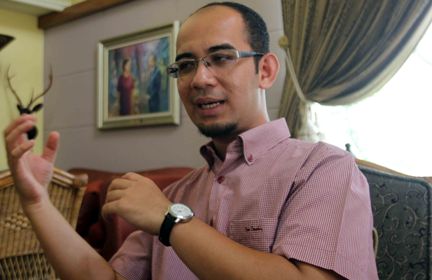
In order to help the public understand PERMAS, its role, political concept and possible relations with the separatist movement, the Isra news desk recently sat down for a hard talk with Artef Soko, former secretary-general of Federation of Students of Thailand and an advisor of PERMAS.
Soko said that the main task of the student body is to publicise the Satu Patani concept to create a new image for Patani; to form network in the drive for mass activities and to undertake political and economic activities.
PERMAS, he said, has focused on eradicating fear among members of the public so that they can express their views freely and without fear of reprisals through various fora a staged by the student body. So far, more than 20 public for a have been held and each time it attracted more than 1,000 participants with a record audience of 7,000 at a recent event held in Pattani.
Soko admitted that it was possible that the public meetings held by the student body were mistaken as an attempt tons incite resentment against the authorities. "But for me, they (accusations) are a commendation that boosts the morale. I do not reject the notion that the meetings amount to incitement of unrest but our 'incitement' was intended to convince the public not to be afraid and to freely express their views," he said.
He admitted there are members within PERMAS who share different views about the separatist movement. “PERMAS offers a forum for people of different views or concepts to express their thoughts freely without the need to take up arms to settle the score.
Soko said that there were grounds for the authorities to suspect a linkage between PERMAS and the separatist gangs because some of the 16 separatists killed during an attack of a marines’ base in Narathiwat’s Bacho district on February 13 were students in the region. But he insisted that the student body subscribed to political solution to the unrest problem.
PERMAS highlights the One Patani or Satu Patani concept and even an idea of an independent state of Pattani can be raised at PERMAS forum.
Personally, the student leader said he would be a lier if he said that he had never thought about the idea of an independent or autonomous Pattani. However, he said those who subscribed to the idea had to be realistic and understand the limitations.
"If Pattani were to become an independent or autonomous state, the first country that it will establish diplomatic relations is Thailand. So, the struggle for this cause is not about hatred but a struggle for self-determination. The hatred was caused by the fighting so the Thai state should be more open-minded and the people are not fighting to seize the power from Bangkok unlike the conflict between the yellow and red shirts," said Soko.
He explained that the student organisation’s fight for justice was not the fight for the cause of the separatists but for the people who were unfairly treated or against whom justice was denied.
Asked why PERMAS has not protested against the arrest of ordinary people, he said that most of them were already taken care of by the state and, therefore, there is no need for the students to intervene. However, there are people who have never been taken care of by the state and these are the people whom the students are helping, he added.
-------------------------------------------------------------------------------------------------------------------------
Caption : Artef Soko