

“...The fact that the state of Thailand still requires people to use titles based on their sex assigned at birth has caused transgender and gender-diverse people to experience difficulties in expressing themselves, deciding how to define their gender identity, and affecting their daily lives,...”
“Gender is not only a matter of specifying or talking about sexual relationships. It also includes lifestyle and daily life. For people whose gender identity does not match their biological sex, it feels like ‘they always wear their shoes backwards, wear their shirts backwards. They feel that their mind does not match their body all the time.’ Therefore, it is necessary to make a transition so that their body matches their mind. Changing the title to match their gender is also an important matter,” Tunyawaj Kamolwongwat, MP of the Move Forward Party, told Isranews (www.isranews.org).
The latest update on this issue is when the House of Representatives voted on the draft bill concerning gender recognition, titles, and the protection of persons with sexual diversity on the 21st of February 2024, . The bill did not pass, with 257 votes against, 154 in favor, 1 abstention, and 1 no vote.
Tunyawaj revealed to Isranews Agency that after the House of Representatives voted to reject the draft of the Gender Recognition Act, he and his team immediately began drafting a new version. This time, they are collaborating with the Hepta-Consortium of Non-binary People for Legal Gender Recognition (HCNL). The new draft is expected to be completed by this July.
No Law to Recognize LGBTQ People
The principles and reasons for the proposal of the Gender Recognition Act to change legal gender markers, which was rejected by the House of Representatives, were grounded in the constitution's stipulation that human dignity, rights, freedoms, and equality of individuals must be protected. However, there is currently no law to recognize LGBTQ people, resulting in ongoing violations of their human dignity, rights, freedoms, and equality. In particular, Thai government documents still mandate the use of titles based on sex assigned at birth, such as boy, girl, Mr., Miss, and Mrs.
Tunyawaj, who presented the draft, stated in the parliament meeting that the absence of this law has caused transgender people and other gender-diverse individuals significant difficulty in expressing themselves and defining their sexual orientation, affecting their lives. He noted that international law and universal human rights principles recognize gender diversity, which acknowledges diverse gender identities and sexual orientations.
“The fact that the state of Thailand still requires people to use titles based on their birth gender has caused transgender people and gender diverse people to have difficulty expressing themselves, deciding to define their sexual orientation, and affecting their lives,” Tunyawaj stated.

Tunyawaj Kamolwongwat, MP of the Move Forward Party
Addressing Concerns that Changing the Title Could Lead to More Crimes
Thirachai Saenkaew, MP for Udon Thani Province and member of the Pheu Thai Party, expressed concerns about the draft bill. He argued that allowing individuals to change their titles as desired might lead to an increase in crime, such as fraud or sexual harassment.
On the issue of incarceration, there are concerns from multiple parties, particularly the Department of Corrections, about how individuals who identify as transgender will be treated if they are convicted of a crime. Specifically, for individuals whose gender identity differs from their sex assigned at birth, it remains unclear whether they would be housed with male or female inmates. There are also concerns that passing this draft law could lead to increased incidents of sexual harassment and physical assault within the prison system.
“Titles such as Mr., Mrs., and Miss are gender-specific from birth and I am concerned about allowing their voluntary change. In other countries, while titles can be changed, there are different rules and conditions. I believe that everyone should have the right to choose their identity and avoid using a title that does not match their current gender. However, in countries like Sweden and Finland, changing titles is not straightforward. It requires psychiatric evaluations and sterilization to prevent misuse. What principles will our country adopt? I am worried that without clear guidelines, the changes could lead to crimes such as deception and molestation, where individuals might exploit title changes to misrepresent their gender,” said Thirachai.
Although the draft Gender Recognition Act proposed by the Move Forward Party was rejected, there are still two other draft laws addressing the same issue currently under consideration by the House of Representatives:
-
The Draft of Gender Recognition Act B.E. ...., by the Department of Women's Affairs and Family Institute.
-
The Draft of Gender Identity, Gender Expression, and Gender Characteristics Recognition Act B.E. .... (also known as the GEN-ACT), drafted by the civil sector.
It’s not a privilege; it’s human rights
Isranews spoke with Rati Taesombat, Director of the Transgender Network Foundation for Human Rights, about the significance of the draft of Gender Recognition Act and the need for changing titles. Rati shared the experience of being frequently questioned about the gender identity by officials, civil servants, immigration officers abroad, and the general public because the gender does not seem to match the title on the ID card, passport, and other important official documents.
“Traveling abroad is a major issue for transgender people because their gender expression often does not match their documents, which only list M (Male) for male and F (Female) for female. I want to share my personal experience traveling to a conference in Hong Kong in 2007, where I was detained at immigration. The officer kept looking back and forth between at me and my passport, before inviting me to a cold, dark room. This happened despite me having all my identification documents, a work certificate, and an invitation letter from the organization. I was judged solely because my gender identity did not match the title on my documents. This incident would not have occurred if I had been able to change my title,” Rati added.
Therefore, changing legal gender markers for transgender people is not a privilege but a restoration of human dignity and a fundamental right of being a citizen in Thai society.

Rati Taesombat, Director of the Transgender Network Foundation for Human Rights
Regarding concerns that changing gender markers could lead to increased fraud or crime, Nachalei Bunyaphisomparn, transgender rights activist, addressed the issue by calling such concerns transphobia. She explained that fears of transgender people deceiving their partners about their gender stem from gender bias and the outdated belief that there are only two genders based on biological sex. Natchalei argued that these concerns should not influence the passage of gender recognition laws for transgenders, as deception and dishonesty occur among individuals of all genders, regardless of whether they are male or female.
Furthermore, sexuality should not be used as proof of love between couples. In reality, how many transgender people in Thailand have only one person around them who cannot tell their sexuality? After all, why do we need to know someone's sex? How does it benefit our relationship with that person? Thai society should learn to respect individuals' autonomy over their own sexual identification without questioning it, as this does not serve any constructive purpose.
“Lastly, don’t forget that transphobia is a choice. We decide whether to hate someone or not based on our own biases. Being born as transgender is not a choice; it happens naturally. The idea that Thai men change their gender to evade military service or escape legal consequences is due to the same biases. Being transgender is not easy; it is not something that can be changed overnight,” said Natchalei.
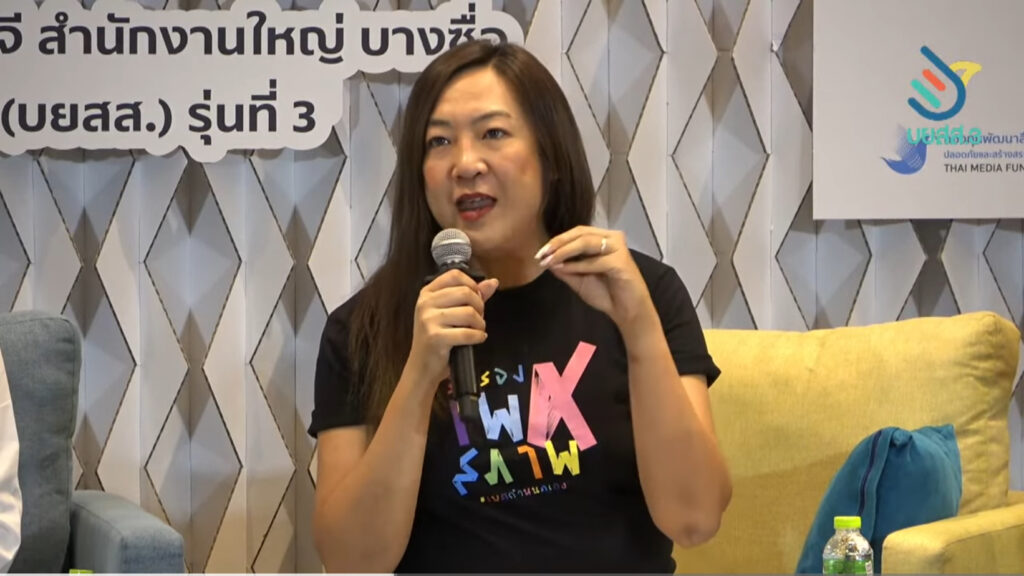
Nachalei Bunyaphisomparn, transgender rights activist
10 Countries Allow Gender Self-Determination
According to the Trans Rights Map 2023 report by Transgender Europe (TGEU), ten countries in Europe—Denmark, Norway, Belgium, Luxembourg, Portugal, Iceland, Malta, Switzerland, Spain, and Finland—currently have laws that allow for gender self-determination. This means individuals can change their name, legal gender, or gender identity based solely on their own wishes, without requiring certification from a third party, such as a judge, psychiatrist, or psychologist.
The European Parliamentary Assembly has emphasized that the best interests of the child are paramount and has highlighted that children should have access to gender identity services without discrimination, regardless of age.
Gender ‘X’
In March 2022, the United States announced that all citizens can choose the gender ‘X’ as an unspecified or gender-neutral option on their passports, without the need for a medical certificate, even if it conflicts with other identity documents.
Currently, 16 states and Washington, D.C., allow residents to select gender marker ‘M’, ‘F’, and ‘X’ on their birth certificates. However, two states, Oklahoma and North Dakota, do not permit changes to the gender marker on birth certificates.
In Thailand, attention remains focused on the draft of the Gender Recognition Act, as well as two other bills related to gender marker changes, and on when these will be reconsidered by the House.


 Isranews Agency | สำนักข่าวอิศรา